

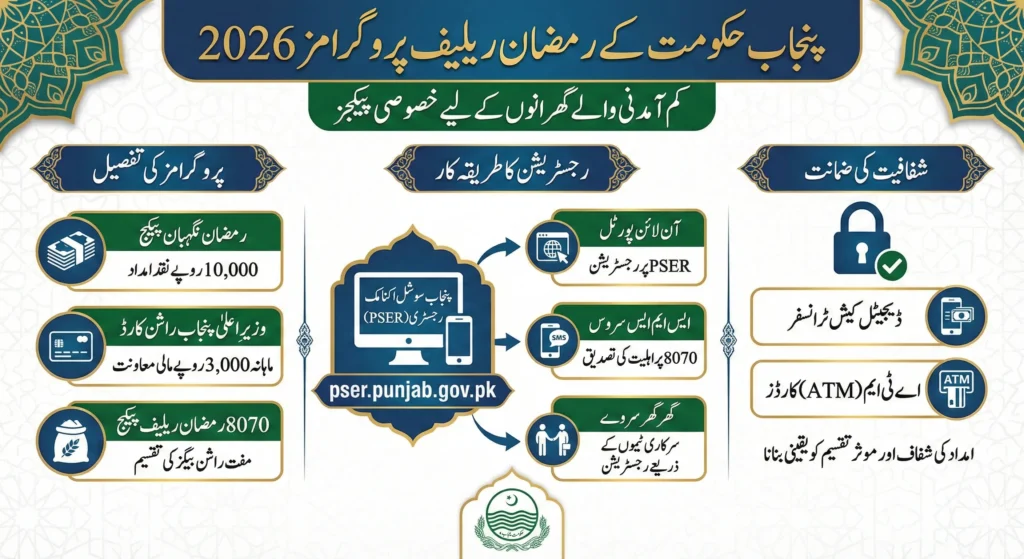
The Punjab government has introduced multiple Ramzan Relief Programs in 2026 to support low-income households during the holy month. The programs include the Ramzan Nigehban Package offering Rs. 10,000 cash assistance, the CM Punjab Ration Card providing Rs. 3,000 monthly support, and the 8070 Ramzan Relief Package delivering free ration bags. Registration for all these programs is managed through the Punjab Socio-Economic Registry (PSER), accessible at pser.punjab.gov.pk. Families can register online through the PSER portal, verify eligibility via 8070 SMS service, or complete registration during door-to-door surveys conducted by government teams. The programs use digital cash transfers and ATM cards to ensure transparent and efficient aid distribution.
Overview of Ramzan Relief Programs 2026
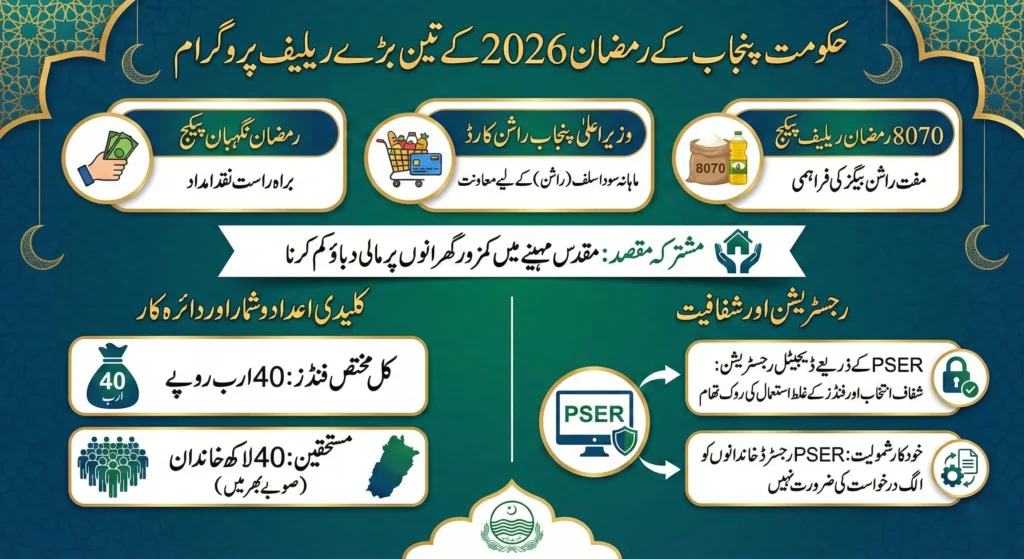
The Government of Punjab operates three major relief programs for Ramzan 2026. The Ramzan Nigehban Package provides direct cash support, the CM Punjab Ration Card offers monthly grocery assistance, and the 8070 Ramzan Relief Package delivers free ration bags to deserving families. All programs work together to reduce financial pressure on vulnerable households during the holy month.
The Punjab government allocated Rs. 40 billion for these initiatives to reach 4 million families across the province. Digital registration through PSER ensures transparent selection and prevents misuse of funds. Families registered in PSER are automatically considered for multiple programs without needing separate applications.
Key Details of the Ramzan Package
The Ramzan relief programs use modern technology to deliver aid efficiently. Digital cash transfers replace traditional manual systems, reducing delays and eliminating middlemen. Families receive assistance through ATM cards linked to their CNIC and mobile numbers, allowing them to withdraw cash or purchase groceries at authorized merchants.
The programs target permanent Punjab residents with household income below Rs. 60,000 per month and a PMT poverty score within approved limits. Government employees and families owning commercial vehicles are excluded to ensure support reaches genuinely deserving households.
Ramzan Nigehban Package 2026
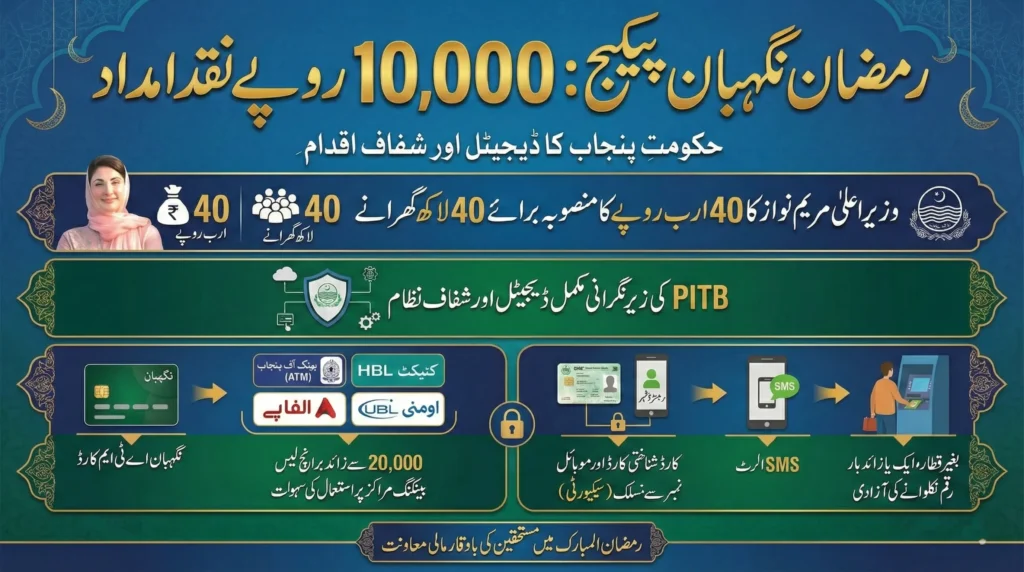
The Ramzan Nigehban Package provides Rs. 10,000 cash assistance to eligible families through digital ATM cards. CM Punjab Maryam Nawaz launched this Rs. 40 billion initiative to support 4 million households during Ramzan. The program uses a fully digital and transparent system supervised by the Punjab Information Technology Board.
Beneficiaries receive Nigehban ATM Cards that can be used at Bank of Punjab ATMs and over 20,000 branchless banking outlets including HBL Konnect, AlfaPay, and UBL Omni. The cards are linked to CNIC and registered mobile numbers for security. Families receive SMS alerts about card collection and can withdraw cash in single or multiple attempts without standing in long queues.
Distribution of Negahban ATM Cards Across Punjab
The distribution of Negahban ATM Cards has officially commenced across Punjab. District administrations established 160 dedicated centers at every tehsil for card activation and cash withdrawal. Eligible families can visit these centers with their CNIC for verification through OTP sent to registered mobile numbers.
The entire process is free with no deductions or hidden charges. Families should avoid agents asking for money and rely only on official sources. Lost cards can be replaced following standard bank procedures with proper documentation.
Key Information Table
| Point | Details |
|---|---|
| Program Name | Ramadan Nigehban Package 2026 |
| Cash Assistance | Rs. 10,000 |
| Distribution Method | ATM Card |
| Total Beneficiaries | 4 Million Families |
| Budget Allocated | Rs. 40 Billion |
| Verification System | PSER (Punjab Socio-Economic Registry) |
| Card Distribution Centers | 160 Tehsil-Level Camps |
| Banking Partners | BOP, HBL Konnect, AlfaPay, UBL Omni |
| Helpline | 08000-2345 |
CM Punjab Ration Card/Rashan Card Program
CM Punjab Maryam Nawaz launched the Ration Card Program on April 29, 2025, to provide food security to low-income families. The program supports 1.25 million families with Rs. 3,000 monthly financial assistance starting from July 1, 2025. Families receive a digital smart card to purchase household groceries at utility stores and registered karyana shops.
The Punjab government allocated Rs. 40 billion for this initiative, including support for 40,000 workers from the Mines and Minerals Department. The program helps families manage basic kitchen expenses and cope with rising inflation through subsidized prices on flour, rice, sugar, ghee, and other essentials.
Objectives of the Ration Card Program
The program aims to provide financial support to low-income families and fulfill their basic food expenses. It works to eliminate food insecurity across Punjab and help communities fight hunger and poverty. The initiative ensures families receive assistance with dignity through a transparent digital system.
The program prioritizes vulnerable groups including widows, elderly persons, disabled individuals, and daily wage earners. Families not receiving BISP benefits and those without stable government employment can apply for support.
Key Benefits
Eligible families receive Rs. 3,000 monthly aid for purchasing household groceries. The program provides discounts on essential items including flour, rice, sugar, ghee, and kitchen staples. Families avoid long queues through digital smart card payments processed at registered merchants.
The card system allows easy use at utility stores and authorized karyana shops displaying program banners or QR codes. Families can track their monthly allowance and spending through the PSER portal, ensuring transparency in fund usage.
8070 Ramzan Relief Package
The 8070 Ramzan Relief Package combines cash assistance with free ration bags for eligible households. The program provides Rs. 10,000 digital cash support along with standardized ration bags containing flour, sugar, rice, ghee, and pulses. Doorstep delivery ensures verified applicants receive assistance without visiting distribution centers.
Families already approved in BISP automatically qualify for the package. The 8070 SMS service enables quick eligibility verification for households without internet access, ensuring digital inclusion across urban and rural areas.
Checking Eligibility via SMS
Families can verify their eligibility using the 8070 SMS service by typing their 13-digit CNIC number and sending it to 8070 from a registered mobile number. The service responds within minutes with eligibility status and further instructions if additional details are needed.
This method works across all mobile networks in Punjab at no cost to applicants. Families receiving confirmation should save the message for reference during registration or card collection. Non-eligible families can request re-survey at PSER centers with updated household information.
Eligibility Criteria for Ramzan Relief Programs
The Punjab government uses strict eligibility rules to ensure fair distribution of Ramzan relief. Verification is done through PSER using NADRA and government records to identify deserving families. Following these conditions prevents misuse and ensures only genuine beneficiaries receive assistance.
General Eligibility
Applicants must be permanent residents of Punjab with valid CNIC as per NADRA records. The mobile number must be registered on the same CNIC to receive OTP verification and program updates. Families should have household income below Rs. 60,000 per month with a PMT poverty score less than 35.
Government employees and their families are excluded due to stable income. Families owning cars, commercial vehicles, or significant property may be disqualified during verification. Only one person per family can apply to prevent duplicate registrations.
Who Can Apply?
Both male and female applicants from deserving families can apply for Ramzan relief programs. Widows, disabled persons, and daily wage earners receive priority consideration during selection. Families without their own house or personal property are eligible to apply.
Non-tax filers can participate in the programs. Individuals registered with Social Security or Worker Welfare are included. Families not receiving BISP benefits can apply, though BISP beneficiaries may automatically qualify for certain packages.
PSER (Punjab Socio-Economic Registry)
PSER is a digital household database created by the Punjab government to record family information for welfare program decisions. The system determines who needs government assistance based on verified socio-economic data. Once registered, families are automatically considered for multiple Punjab welfare schemes without repeated applications.
The registry covers programs including Ramzan relief packages, Punjab subsidies, health and education assistance, and other provincial welfare initiatives. PSER registration has become the foundation of all major relief programs in Punjab, replacing manual lists and local recommendations.
Why PSER Registration Is Mandatory
All decisions for Ramzan relief are made using verified PSER data. Families without registered or updated information may miss relief packages even if they truly deserve support. The government no longer uses political influence or local recommendations for beneficiary selection.
PSER ensures fair and transparent selection with faster processing during relief phases. One-time data entry is used for multiple schemes, saving families from registering separately for each program. Complete PSER profiles are processed faster, while incomplete data causes delays.
Benefits of PSER Registration
PSER registration provides several advantages for families seeking government assistance. The system eliminates political or local influence in beneficiary selection. Digital verification reduces paperwork and speeds up approval processes. Families can track their application status online without visiting government offices.
Registration is completely free with no processing charges. Families registered in PSER receive consideration for future welfare programs automatically. The system reduces duplication and human error through digital verification linked with NADRA.
Programs Covered by PSER
PSER registration makes families eligible for multiple Punjab government programs. These include the Ramzan Nigehban Package, CM Punjab Ration Card, 8070 Ramzan Relief Package, Kisaan Card for farmers, Himmat Card for youth, Health Card for medical assistance, Livestock Card for animal farming support, E-Bike Scheme, scholarship programs, Apni Chaat Apna Ghar housing scheme, and Roshan Gharana Solar Program.
Families benefit from a single registration that opens access to various support programs based on their specific needs and eligibility criteria.
How PSER Data Is Collected (Door-to-Door Survey)
PSER data is collected through three methods: online self-registration via the official portal, door-to-door surveys by trained government teams, and digital verification linked with CNIC through NADRA. CM Punjab Maryam Nawaz assigned Deputy Commissioners in each district to complete PSER surveys as part of their monitoring duties.
Government survey teams visit homes to register families and verify household information. Teams confirm CNIC details, family size, income sources, living conditions, and asset ownership. This approach ensures rural and remote area families without internet access are included in welfare programs.
Difference Between PSER and Other Welfare Systems
PSER operates at the provincial level specifically for Punjab-based programs, while other welfare systems like BISP function at the federal level for national assistance. PSER uses household-based data collection, whereas other systems may focus on program-specific information.
Registration in PSER does not replace registration in federal programs like BISP. Families may need to register in both systems to access the full range of available welfare benefits. Each system serves different purposes and covers different assistance programs.
PSER Online Registration Process (2026)
The pser.punjab.gov.pk portal allows applicants to complete registration fully online from home without visiting government offices. The portal is user-friendly and secure, supporting all required documentation uploads. Matching CNIC and mobile number with NADRA records is essential to avoid delays.
Step-by-Step PSER Online Registration
Visit pser.punjab.gov.pk and click the Register button or navigate to https://pser.punjab.gov.pk/register. Enter your full name, 13-digit CNIC number, registered mobile number, network name, and email address. Create a strong password and save it for future portal access and application submissions. Enter the password again to confirm accuracy, then click the Register button to create your account.
After registration, log in to the portal and click “New Application” to start the PSER registration process. A declaration form appears asking you to provide all information truthfully. Read the declaration thoroughly, check the box, and proceed if you agree to continue.
Enter the name and CNIC of your family head in the first step. Provide basic details including gender and date of birth. In the health section, include information about any disability or chronic diseases affecting family members.
Provide educational history with level, degree, and reasons for illiteracy if applicable. Enter employment status details including last month’s income, income source, and job type. Add two registered mobile numbers with their network names for contact purposes.
Enter current and permanent addresses with province, union council, district, city, or village details. Provide information about assets, wall and roof materials, residential condition, toilet facility, water source, electricity connection, livestock, agricultural land, and vehicle ownership if any.
If you own agricultural land, provide cultivation type and land size details. In the final section, include information about other financial aid received, mobile and internet facilities, and any past accidents affecting family members.
Review your complete application carefully before submission. Double-check CNIC, mobile number, household income details, and family members’ B-Form numbers. Save your Tracking ID for future reference and keep copies of uploaded documents. Submit the application to complete your PSER registration.
Registration via 8070 SMS for Non-Internet Users
Families without internet access can use the 8070 SMS service to check eligibility and begin registration. Type your 13-digit CNIC in a message without dashes or spaces. Send the message to 8070 from a mobile number registered on your CNIC. Wait for a response indicating your eligibility status.
If additional details are needed, the SMS will guide you to visit the nearest PSER center or Union Council office. This method ensures digital inclusion for all households regardless of internet availability.
Completing Socio-Economic Survey
The socio-economic survey determines the financial status of each household for PMT score calculation. Accurate data helps the government assess eligibility correctly. Incorrect information may delay or reject applications.
Required documents include family details with B-Form numbers for children, household income and sources of earnings, recent electricity or gas bills, front and back copies of CNIC, and widow or disability certificates if applicable. Proper preparation of documents ensures a smooth registration process and faster verification.
Final Checklist Before Submission
Before submitting your PSER application, verify all information carefully. Confirm family members’ B-Form numbers are entered correctly. Save your Tracking ID for tracking application status and future reference. Keep copies of all uploaded documents for your records.
Cooperate with PSER survey teams if they visit your home for verification. Ensure your mobile number remains active to receive updates via SMS. Check your CNIC expiry date and renew it before application if expired. Provide complete and accurate information to avoid rejection during verification.
How to Apply for Specific Programs
Families can apply for specific Ramzan relief programs through different methods based on program requirements. Online registration through PSER is the primary method, while offline options are available at Union Council offices and e-Khidmat Markaz centers.
Ramzan Nigehban Package Application
Families already registered in PSER are automatically considered for the Ramzan Nigehban Package. New applicants must complete PSER registration through the online portal or door-to-door survey teams. After registration, the government verifies data using NADRA records and calculates PMT scores.
Eligible families receive SMS notifications about their selection. District administrations contact beneficiaries for ATM card collection at tehsil-level distribution centers. Families should bring their original CNIC and registered mobile number for OTP verification during card activation.
CM Punjab Ration Card Application
The CM Punjab Ration Card application follows the PSER registration process. Families registered in the Nigehban Ramadan Package are automatically included in the Ration Card applicant list without needing separate registration. This saves time and avoids data duplication.
Step 01: Click the Apply Button
Start by visiting the PSER portal at pser.punjab.gov.pk. Look for the application section and click the Apply or New Application button to begin the registration process.
Step 03: Apply PSER Registration
Complete the PSER registration form with accurate household information. Enter details about family head, health status, education, employment, income, address, assets, and other relevant information. This data determines eligibility for the Ration Card and other welfare programs.
Step 04: Application Submission
Review your application thoroughly before final submission. Check all entered information for accuracy. Make sure CNIC numbers, mobile numbers, and income details are correct. Submit the application and save the confirmation message or Tracking ID for future reference.
Important Note
If you face difficulty applying online or want to avoid mistakes, visit your nearby PSER registration center. The Punjab government established 5,000 PSER registration centers in all tehsils and divisions across Punjab. You can also call the helpline 0800-02345 for assistance. Check eligibility or application status by sending your 13-digit CNIC to 8123 via SMS.
Offline Application for Ration Card
Families without internet access can apply through offline methods at government offices. Two main options are available: Union Council registration and e-Khidmat Markaz assistance.
Union Council Registration
Visit your area’s Union Council office or local government office with original documents. Bring your valid CNIC, registered phone number, and documents containing family information. Ask a staff member or Union Council officer to fill out the application form on your behalf. Review the completed form carefully and submit your application.
e-Khidmat Markaz
Visit your nearest e-Khidmat Markaz and ask staff to check your eligibility for the Ration Card Program. Bring your CNIC, registered phone number, and other documents with family information. The staff will verify your eligibility, provide necessary details, and apply for the CM Punjab Ration Card on your behalf. They will guide you about next procedures and expected timelines.
PSER Door-to-Door Survey
PSER teams are conducting door-to-door surveys across Punjab, visiting homes to register families. These teams collect household data and register applicants on their behalf. Deputy Commissioners in each district monitor survey completion as assigned by CM Punjab Maryam Nawaz.
Remember that PSER Survey registration is mandatory for eligibility in other CM Punjab programs including Kisaan Card, Himmat Card, Health Card, Livestock Card, E-Bike Scheme, scholarship programs, Apni Chaat Apna Ghar Scheme, and Roshan Gharana Solar Program.
8070 PSER Ramzan Package Application
Families registered in PSER are automatically considered for the 8070 PSER Ramzan Package. New applicants should first complete PSER registration through the online portal or door-to-door survey. Check eligibility by sending your 13-digit CNIC to 8070 via SMS.
The government verifies registered families using NADRA and PSER records. Eligible households receive confirmation messages with instructions for receiving cash assistance and free ration bags. No separate application is required if you are already in the PSER database.
ATM Card Distribution (Nigehban Package)
The ATM card distribution for the Nigehban Package uses a modern digital system for secure and efficient fund delivery. This replaces traditional manual payment methods that caused delays and long queues in previous years.
ATM Card System Launched
The Punjab government launched a modern ATM card system for the Nigehban Ramzan Card 2026. Eligible families receive direct cash assistance through ATM cards instead of ration bags or manual payments. This allows families to manage their Ramzan expenses independently according to their needs.
Cards Linked with CNIC & Mobile Number
Each ATM card is linked to the beneficiary’s CNIC and registered mobile number for security. Families can withdraw cash at Bank of Punjab ATMs or use the card at authorized merchants for purchases. The cards remain valid for future Ramzan packages and other welfare programs, eliminating the need for reissuing cards each year.
Tehsil-Level Camp Sites for Card Distribution
District administrations established tehsil-level camps across Punjab for card distribution. These camps are set up in every tehsil to ensure convenient access for beneficiaries. CNIC and mobile number verification is done through OTP sent to registered numbers during the activation process.
The entire process is free with no fees or deductions at any stage. Families should rely only on official sources and avoid agents demanding money for card activation or collection.
Cash Withdrawal Process
Beneficiaries can withdraw cash from Bank of Punjab ATMs using their Nigehban ATM cards. The cards also work at over 20,000 branchless banking outlets including HBL Konnect, AlfaPay, and UBL Omni across Punjab. Families can withdraw the full amount in one attempt or make multiple withdrawals based on their needs.
PIN-based security protects funds from unauthorized access. Families receive their PIN during card activation at distribution centers. Lost or stolen cards can be blocked immediately by calling the helpline, and replacement cards can be issued following standard bank procedures.
Checking Application/Registration Status
Families can check their application and registration status through multiple methods. Regular status monitoring helps track verification progress and confirm eligibility for relief programs.
PSER Registration Status
Log in to the PSER portal using your CNIC and password. Navigate to your dashboard where application status is displayed. The portal shows current status and any pending requirements or documentation needed for verification.
You can also call the PSER helpline at 0800-02345 for status updates. Another option is sending your 13-digit CNIC to 8123 via SMS to receive status information on your mobile phone.
Status Meanings
Different status indicators show application progress. “Verified” status means your data has been approved and you are eligible for future relief programs. “Under Review” indicates that data verification is in progress and officials are checking your information against NADRA and government records.
“Pending” status suggests additional documentation or information is required. “Incomplete” means you need to log in and complete remaining sections of your application. Processing may take time during peak periods, so checking daily is unnecessary.
Punjab Ration Card Application Status
To check Punjab Ration Card application status, visit the PSER website or https://ehsaas.punjab.gov.pk/. Enter your login details to access your portal account. Your dashboard displays the current Ration Card application status and any updates.
You can also visit your nearby e-Khidmat Markaz for status verification or call the PSER helpline 0800-02345 for assistance. Sending your CNIC to 8123 via SMS also returns your application status.
8070 PSER Ramzan Package Status
Check 8070 PSER Ramzan Package status by sending your 13-digit CNIC to 8070 via SMS. The system responds with eligibility status and information about whether your application has been approved. You can also check online through the PSER portal by logging into your account.
Visit the official PSER portal and enter your CNIC to view eligibility results instantly. This online verification is secure and provides accurate information without visiting government offices.
Using the CM Punjab Rashan Card
After receiving the CM Punjab Rashan Card, families can use it to purchase groceries at subsidized prices. The card makes shopping convenient and eliminates the need for standing in long queues.
Where Can You Use the Ration Card
The CM Punjab Rashan Card works at three types of locations. Families can use it at Utility Store Corporation of Pakistan outlets. The card is accepted at registered merchants, karyana stores, and shops enrolled in the program. Ehsaas Ration centers also accept the card for subsidized grocery purchases.
Registered stores display program banners or QR codes outside their shops. This helps families identify authorized merchants where they can use their Rashan Card for purchases.
CM Punjab Ration Card Merchant List – Check Online
The complete merchant list is available online showing all registered stores across Punjab. Families can find nearby registered merchants in their areas including Lahore, Faisalabad, Multan, Gujranwala, Sargodha, Sheikhupura, Sialkot, Rawalpindi, and other cities.
To check the merchant list, visit the official PSER portal or download the published list. The list includes merchant names, addresses, and contact information to help families locate convenient shopping locations near their homes.
Important Information & Guidelines
Following important guidelines ensures smooth application processing and successful receipt of Ramzan relief benefits. Families should pay attention to specific requirements and avoid common mistakes.
Important Guidelines for Applicants
Provide correct information in your application to avoid verification delays. Review your application thoroughly before submission to catch errors. Register only through official portals or websites to protect your data. Never pay any charges for application fees, as registration is completely free.
Provide your active mobile number to receive program updates and SMS notifications. Visit your PSER portal regularly to check application status and respond to any requests for additional information. Stay updated about program developments by checking official sources regularly.
Mistakes to Avoid While Applying for the CM Punjab Rashan Program 2026
Always check your CNIC expiry date before applying, as expired CNICs will not be accepted and applications will be rejected. Your mobile number must be registered on your CNIC to receive OTP codes for verification. Use the correct mobile phone number during registration to avoid missing verification messages.
Submit only one application per family, as multiple applications will be rejected automatically. Provide accurate information about assets and household income, as this is critical for application acceptance. Incorrect information leads to rejection and may result in legal action.
Complete all sections of the application form with as much detail as possible. Applications with more complete and correct information are approved earlier than incomplete submissions.
Updating PSER Information
Families must update their PSER profile when household circumstances change. Keeping data current ensures fair assessment for future programs and prevents disqualification due to outdated information.
Update Required If:
Update your PSER information if your household income changes significantly. Changes in your residential address require profile updates to ensure correspondence reaches you. If family size changes due to births, deaths, marriages, or separations, update this information promptly.
Updates can be made through the online PSER portal by logging into your account. Survey teams visiting your area can also update information during door-to-door verification. Visit your nearest PSER center or Union Council office for assistance with updates.
Budget Allocation and Transparency Measures
The Punjab government allocated Rs. 40 billion for Ramzan relief programs in 2026. This substantial budget covers cash assistance, free ration bags, ATM card production, distribution logistics, and operational expenses. The allocation ensures 4 million families receive support during the holy month.
Special attention is given to transparency and monitoring throughout program implementation. The Punjab Information Technology Board supervises the entire registration and distribution system to ensure accountability at every stage. Digital dashboards help officials track progress in real time across all districts.
Regular audits and reporting systems reduce corruption and errors in beneficiary selection. Media briefings and public updates are shared to maintain trust and keep citizens informed. The government publishes progress reports showing fund utilization and beneficiary coverage across Punjab.
Common Registration Issues and Solutions
Many applicants face problems during registration due to minor errors. Understanding common issues and their solutions helps families complete applications successfully without delays.
Login errors often occur when applicants forget their password. Use the “Forgot Password” option to reset your password using your registered CNIC. If your CNIC shows as already registered but you cannot access the account, contact the helpline for assistance.
Missing OTP codes usually happen when the mobile number is not properly linked to your CNIC. Verify that your SIM card is registered under your CNIC with the mobile network operator. Check network connectivity and try requesting OTP again after a few minutes.
Low poverty score issues can be addressed by requesting a re-survey at your PSER center or Assistant Commissioner office with updated household and income details. Bring supporting documents showing your actual financial situation.
Document rejection occurs when uploaded files are unclear or incomplete. Take clear photos or scans of documents ensuring all text is readable. Upload files in the correct format and size as specified on the portal. Make sure CNIC copies show both front and back sides clearly.
Official Help and Contact Information
Families facing difficulties during registration or needing assistance can reach official government channels. Using these official sources ensures accurate information and proper support.
PSER Helpline
The official PSER helpline number is 0800-02345. This toll-free number provides assistance for registration guidance, eligibility queries, application status, and complaint resolution. Helpline staff can answer questions about documentation requirements and program details.
You can also email support at [email protected] for written assistance. The official website punjab.gov.pk and pser.punjab.gov.pk provide comprehensive information about all programs. Visit these websites for forms, guidelines, merchant lists, and program updates.
FAQs
How can I apply for the Ramzan Relief Package 2026?
Apply online via the PSER Portal at pser.punjab.gov.pk by entering your CNIC and family details, or check eligibility by sending your CNIC to 8070 via SMS.
What is the cash assistance amount in the 2026 package?
Eligible families receive Rs. 10,000 cash assistance through the Ramzan Nigehban Package along with free ration bags.
Who can I contact if I face problems during registration?
Call the toll-free helpline 0800-02345, email [email protected], or visit the official Punjab government website for guidance and support.
When was the Punjab Ration Card Program started?
The program was announced on April 18, 2025, launched on April 29, 2025, and financial support to eligible families started on June 1, 2025.
How many members from a family can apply?
Only one member per family can apply for Ramzan relief programs. Multiple applications from the same family will be rejected.
What is PSER Online Registration 2025 Last Date?
There is no last date to apply for PSER Survey Registration. You can apply anytime by visiting your nearby PSER registration center or through the official website.
How to check Ration Card status in Pakistan?
Check Ration Card status by visiting the PSER Portal and logging into your account, calling helpline 0800-02345, or visiting nearby e-Khidmat Markaz.
How to check Ration Card status online?
Visit the PSER website at pser.punjab.gov.pk and log in to your portal using your CNIC and password. Your dashboard displays the current application status.
Is there any registration or application processing fee?
There is no application processing fee for any Ramzan relief program. Registration is completely free and you should not pay any charges to anyone.
How much will be provided to eligible families?
Eligible families receive Rs. 10,000 through the Ramzan Nigehban Package and Rs. 3,000 monthly through the CM Punjab Ration Card Program for household groceries.
Can I apply if I am not a resident of Punjab?
These programs are launched by CM Punjab for Punjab residents only. Individuals from other provinces are not eligible to apply.
Where can I use the Rashan Card?
Use the Rashan Card at Utility Store Corporation outlets, registered karyana shops and merchants displaying program banners, and Ehsaas Ration centers across Punjab.
Conclusion
The Ramzan Relief Programs in Punjab 2026 provide comprehensive support to low-income families through the Nigehban Package, Ration Card, and 8070 Relief Package. Registration through PSER at pser.punjab.gov.pk ensures transparent and efficient aid distribution using digital systems. Families can register online, verify eligibility via 8070 SMS, or complete registration during door-to-door surveys. The programs use ATM cards and digital payments to deliver Rs. 10,000 cash assistance and Rs. 3,000 monthly grocery support to deserving households. Accurate information submission and PSER registration are essential for receiving timely assistance during the holy month of Ramzan.
